
Venezuela Crisis Oil Trading Strategy IV: Decision Framework
Part 4: Decision Framework, OPEC+ Scenarios, and the Operational Playbook

This is the PART 4 of a standalone series on the Venezuela Crisis Oil Trading Strategy.
The previous three parts established the thesis (volatility + relative value > directional oil), mapped the sectors (services and refiners win across scenarios), and detailed implementation (option structures and sizing).
This final part provides the operating system: how to update views as information arrives, how OPEC+ decisions shift the entire regime, and a one-page playbook for the next 6-18 months.
The OPEC+ Decision Tree
OPEC+ is the swing factor that converts geopolitical risk into either:
A volatility regime (if supply stays loose), or
A directional oil regime (if supply tightens)
Their Sunday meeting is expected to confirm a pause on production changes through Q1 2026. But subsequent meetings will be pivotal. Here’s how each outcome changes the trade:
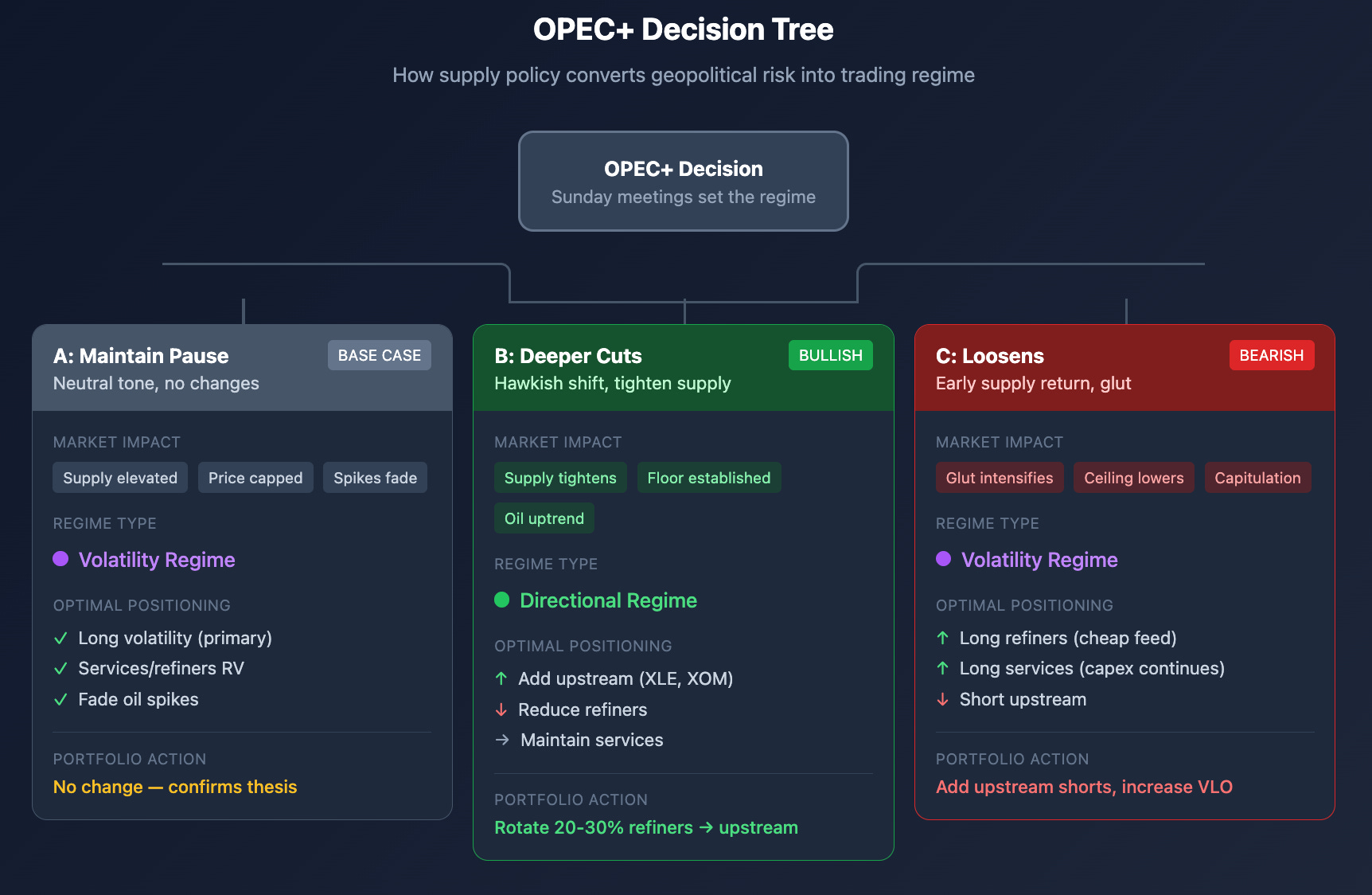
OPEC+ Scenario A: Maintain Pause + Neutral Tone (Base Case)
What it means:
Supply stays elevated
Oil price capped
Spikes fade
Optimal positioning:
Long volatility (primary)
Services/refiners relative value
Fade oil rallies after geopolitical spikes
Portfolio adjustment: None — this confirms base case thesis.
OPEC+ Scenario B: Hawkish Shift / Deeper Cuts
What it means:
Supply tightens
Durable floor established
Potential oil uptrend
Optimal positioning:
Add upstream beta (XLE, XOM, CVX outright)
Reduce refiner overweight (crack spread compression risk)
Maintain services (still benefits from any investment)
Portfolio adjustment:
Rotate 20-30% from refiners to upstream
Convert put spreads on oil to call spreads
Tighten stops on fade trades
OPEC+ Scenario C: Looser Compliance / Early Supply Return
What it means:
Supply glut intensifies
Oil price ceiling lowered
Producer capitulation risk
Optimal positioning:
Long refiners (cheap feedstock + solid margins)
Long services (capex still happens at lower prices)
Short upstream (weak pricing power)
Portfolio adjustment:
Increase refiner allocation
Add explicit upstream shorts
Maintain vol positions (chaos still reprices)
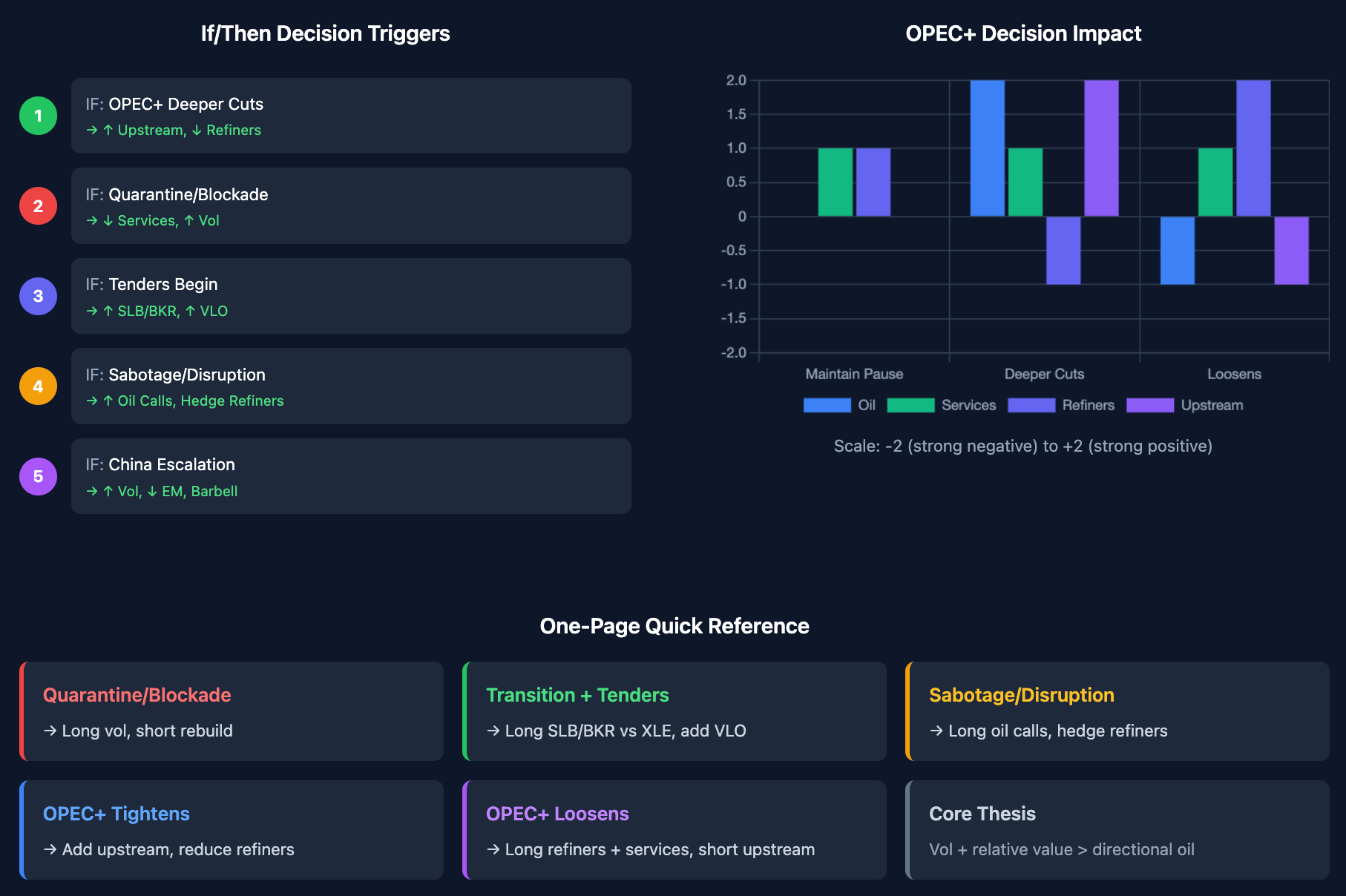
If/Then Decision Triggers
Rather than reacting to every headline, we use specific trigger events that cause material probability shifts. When a trigger fires, we adjust.
Trigger 1: OPEC+ Shifts Toward Deeper Cuts
Signal: Official statement announcing production reductions beyond current commitments, or hawkish surprise from Saudi/UAE leadership.
Probability shift: S7 (OPEC+ tightens) increases from background to primary scenario.
Action:
Increase upstream beta (long CVX/XOM calls)
Reduce refiner overweight by 50%
Convert any short oil calls to long calls
Trigger 2: U.S. Policy Solidifies Around Quarantine/Blockade
Signal: Official designation of oil exports as sanctioned, enforcement actions against buyers, sustained rhetoric against reopening.
Probability shift: S1 (quarantine) becomes dominant; rehabilitation scenarios fade.
Action:
Shrink rebuild exposure (reduce SLB/BKR by 50%)
Emphasize vol + defensive hedges
Short the rebuild basket vs. long volatility
Trigger 3: Contract Reopening + Tenders Begin
Signal: OFAC licenses issued, PDVSA announces international tenders, Chevron announces expansion plans, other majors signal return.
Probability shift: S2/S3 (transition + rehab) probability increases significantly.
Action:
Complete SLB/BKR position build-out
Add second tranche of refiner exposure
Reduce pure volatility positions (vol may compress as uncertainty resolves)
Trigger 4: Sabotage/Export Disruptions Confirmed
Signal: Attacks on oil infrastructure, port blockages, pipeline incidents, production shut-ins.
Probability shift: S4 (sabotage/disruption) moves from 5% to 20%+.
Action:
Remove any short oil calls immediately
Add oil upside via call spreads
Hedge refiner positions (short-term margin compression)
Services still valid but delayed
Trigger 5: China Retaliation Escalates Beyond Rhetoric
Signal: Trade measures specifically targeting U.S. energy sector, military positioning, cyber incidents, shipping interference.
Probability shift: S5 (U.S.-China escalation) increases from background to material.
Action:
Increase volatility and tail hedges
Reduce EM exposure (LATAM especially)
Barbell positioning: energy upside + defense stocks
Avoid concentration in any single scenario bet
Trigger 6: Mining Sector Policy Crystallizes
Signal: Orinoco Mining Arc tenders announced, Chinese mining companies expelled, U.S. critical minerals task force includes Venezuela, any major (Rio Tinto, BHP, Newmont) announces exploration interest.
Probability shift: Minerals angle moves from background optionality to active trade.
Action:
Deploy minerals LEAPS allocation (Structure 8)
Add gold miners (NEM, GDX) if supply disruption narrative
Add MP Materials if rare earth access narrative
Watch for CAT/mining equipment as infrastructure play
Key insight: Minerals signal U.S. commitment to long-term engagement. If minerals policy crystallizes, the Syria/Hybrid scenarios become more likely because the U.S. has strategic reasons to stay committed.
Monitoring Dashboard
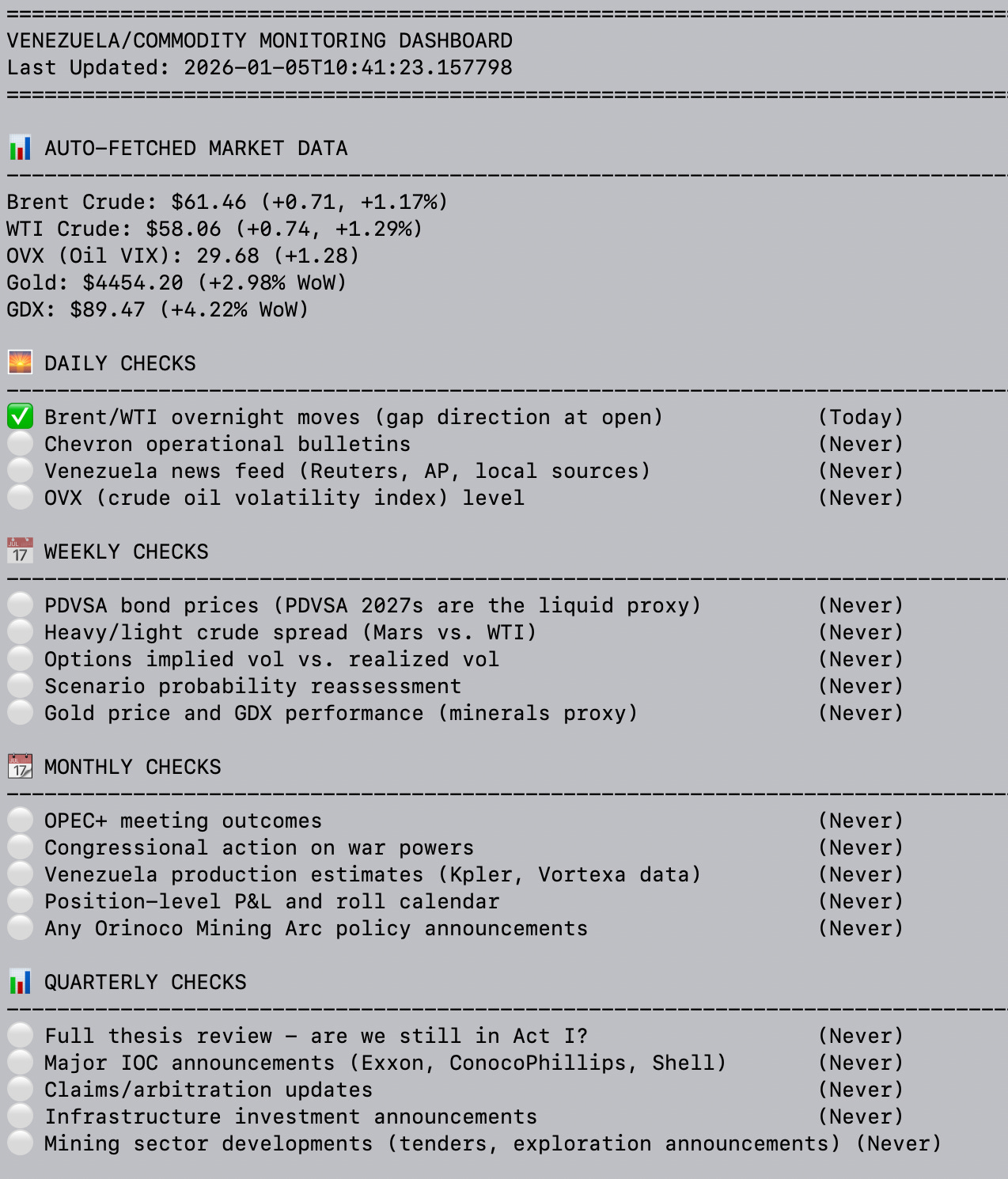
Daily Checks
[ ] Brent/WTI overnight moves (gap direction at open)
[ ] Chevron operational bulletins
[ ] Venezuela news feed (Reuters, AP, local sources)
[ ] OVX (crude oil volatility index) level
Weekly Checks
[ ] PDVSA bond prices (PDVSA 2027s are the liquid proxy)
[ ] Heavy/light crude spread (Mars vs. WTI)
[ ] Options implied vol vs. realized vol
[ ] Scenario probability reassessment
[ ] Gold price and GDX performance (minerals proxy)
Monthly Checks
[ ] OPEC+ meeting outcomes
[ ] Congressional action on war powers
[ ] Venezuela production estimates (Kpler, Vortexa data)
[ ] Position-level P&L and roll calendar
[ ] Any Orinoco Mining Arc policy announcements
Quarterly Checks
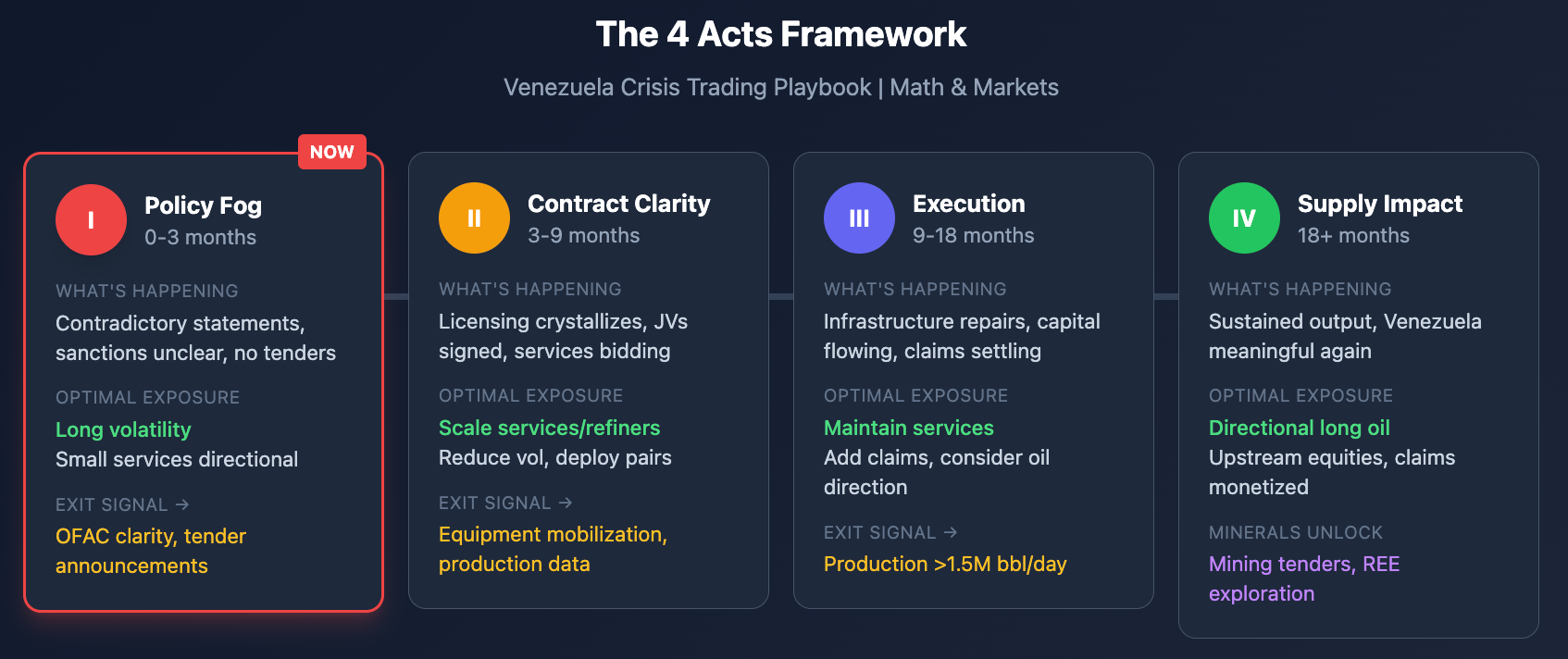
[ ] Full thesis review - are we still in Act I?
[ ] Major IOC announcements (Exxon, ConocoPhillips, Shell)
[ ] Claims/arbitration updates
[ ] Infrastructure investment announcements
[ ] Mining sector developments (tenders, exploration announcements)
One-Page Operational Playbook
If U.S. Policy = Quarantine/Blockade
→ Long volatility
→ Short rebuild basket
→ Avoid services directional
→ Maintain defensive energy exposure (CVX)
If U.S. Policy = Transition + Tenders
→ Long SLB/BKR vs. short XLE
→ Add VLO/refiners
→ Reduce pure vol allocation
→ Watch for Act II → Act III transition
If Sabotage/Disruption Emerges
→ Long oil calls + long volatility
→ Hedge refiners (short-term margin risk)
→ Close any short oil positions immediately
→ Services valid but delayed—hold, don't add
If OPEC+ Tightens
→ Increase upstream exposure (CVX, XOM calls)
→ Reduce refiner overweight
→ Services still work—maintain
→ Directional long oil becomes viable
If OPEC+ Loosens / Oversupply Persists
→ Long refiners + services
→ Short upstream (E&Ps, majors)
→ Fade oil spikes
→ Vol still elevated—don't abandon
Historical Analogues: What Worked and What Didn’t
Understanding past interventions helps calibrate expectations:
Panama (1989)
Event: U.S. invasion, Noriega captured
Oil impact: +8% spike, fully reverted in 2 weeks
Lesson: Low stakes = low lasting impact
Iraq Invasion (2003)
Event: Major military operation, regime change
Oil impact: +25% run-up, then -30% collapse
Lesson: Market overpriced disruption risk, then corrected
What worked: Fading the spike after initial panic
Libya Civil War (2011)
Event: Gaddafi overthrown, prolonged instability
Oil impact: +20% sustained for 2+ years
Lesson: Light sweet crude disruption is harder to replace
What worked: Sustained long on vol and quality spreads
Venezuela Sanctions (2019)
Event: U.S. sanctions on PDVSA
Oil impact: +5% then fade within 3 months
Lesson: Market already expected disruption; production already declining
What worked: Nothing material—event was priced
Key pattern: Markets typically overprice immediate disruption risk, then underprice prolonged instability. The edge is in timing — not predicting the event, but predicting the fade or the persistence.
The 4 Acts: Where Are We Now?
Final Position Sizing Summary
POSITION SIZING SUMMARY
==============================================================================
Position              Allocation    Entry Now?        Scaling Trigger
------------------------------------------------------------------------------
XLE vol structure     18%           Yes               Already entered
SLB call spread       15%           Yes (50% now)     Tenders -> full position
BKR diagonal          10%           Yes               -
VLO collar            12%           After UN meeting  OPEC+ clarity
Pairs (SLB vs XLE)    15%           Wait              Act II confirmed
USO put spread        8%            After first spike Spike > $65
COP LEAPS             5%            No                Settlement mechanism
Mining/REE LEAPS      5%            No                Mining Arc tenders
Hedge (GLD/macro)     12%           Yes               - (also minerals proxy)
==============================================================================
Total risk budget: ~6% of portfolio (half-Kelly)
Note: GLD allocation does double duty as escalation hedge AND gold/minerals proxy — but Mohamed A. El-Erian noted that Gold and Oil (as commodities) will likely decouple
Series Conclusion: The Core Thesis
After all of this analysis, the thesis distills to this:
The Venezuela shock is primarily a volatility and relative value opportunity, not a directional oil bet.
Volatility wins in every scenario because policy fog creates repeated repricing events
Services (SLB/BKR) are the highest-torque play because any recovery is a capex story first
Refiners (VLO) offer targeted exposure to heavy crude economics without oil direction risk
Critical minerals are the hidden story - $1.36T in gold, coltan, rare earths explains U.S. strategic commitment
Directional oil is a low-Sharpe trade given the variance across scenarios
The “chess” approach means matching exposures to the current Act, not predicting the finale
The market wants you to bet on headlines. The edge is in betting on structure.
Full Series Index
Part 1: The Event, The Scenarios, and Why This Isn’t About “Oil Up”
Part 3: Implementation - Option Structures, Position Sizing, and Risk Management
Part 4: Decision Framework, OPEC+ Scenarios, and the Operational Playbook (this post)
Remember: Alpha is never guaranteed. And the backtest is a liar until proven otherwise.
These posts are about methodology, not recommendations. Some of the approaches discussed here involve commodities (like oil) and complex instruments (e.g., options and derivatives) and not suitable for all investors. Many of my analyses probably contain errors — if you find them, please let me know.
While I may hold positions in some of the underlying assets discussed here, my posts are not an endorsement or a recommendation of those underlying assets. This is a quickly emerging and fast-changing situation, so please be wary of information staleness.
The material presented in Math & Markets is for informational purposes only. It does not constitute investment or financial advice.
What is the definition of the term "Probability shift"?
Also what is "S7"? (if it is a "scenario" I do not see it listed)