

On July 29 I published The NVDA 0DTE FOMC Trade Is a Lottery Ticket — Part 1 of a three-part arc on the short-dated NVDA options trade where retail keeps losing money. The argument was that the trade looked like a leveraged bounce play but the historical distribution across 28 prior FOMC events told a different story: mean +151.7% on paper, median −45.6%, hit rate 42.9%, with three tail events out of 28 driving the entire positive mean. Strip those three out and the mean flips to −2.4%. Theta is a certain loss on every single event. What you’re actually buying is a lottery ticket that’s been priced to look like leverage.
Well, the trade ran, the call went to zero, and this is what actually happened. The annoying part is that the mean-reversion trade that would have rescued the position did eventually show up — it just showed up 24 hours after the 0DTE contract had already expired.
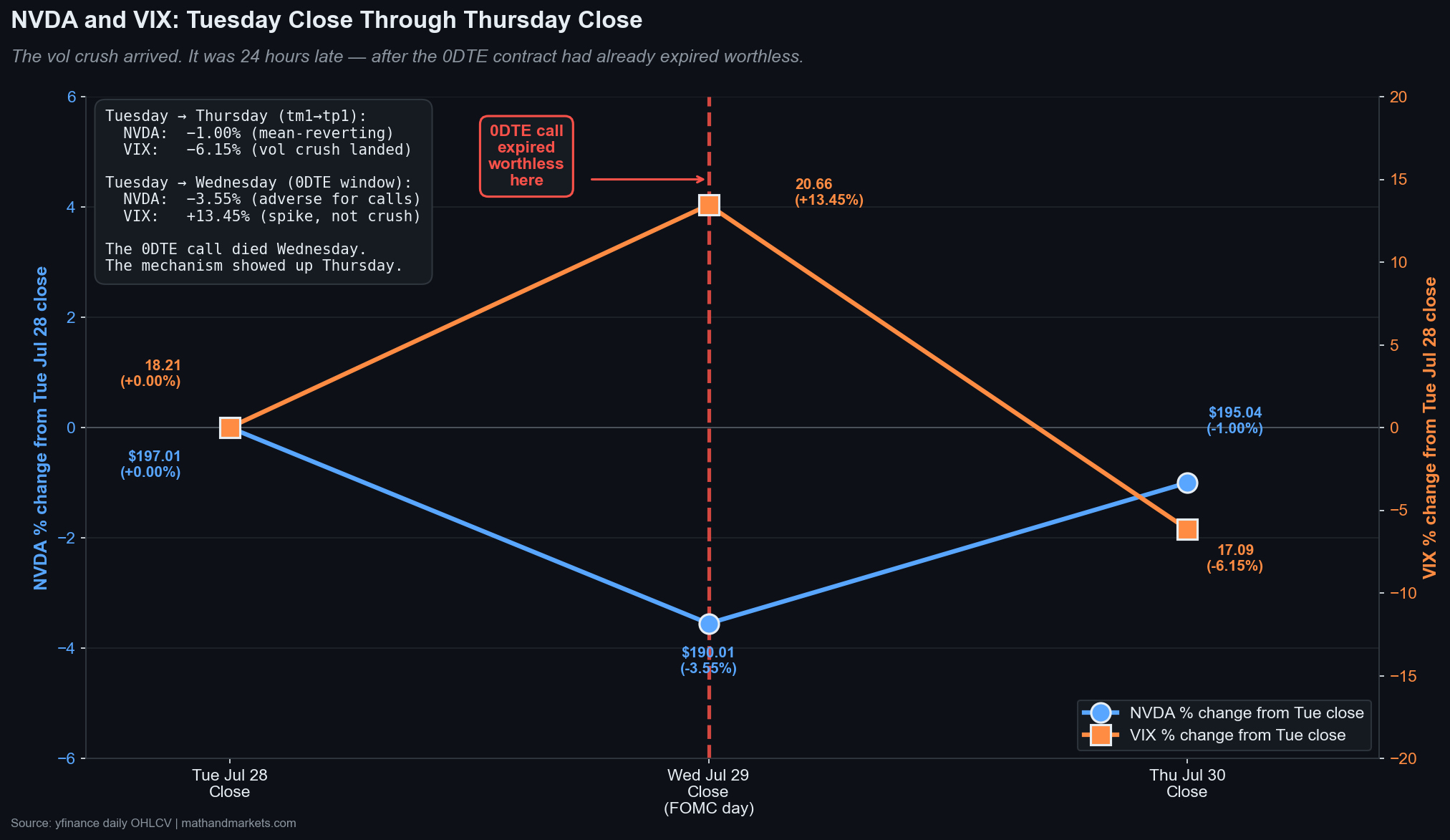
NVDA + VIX from Tue Jul 28 close through Thu Jul 30 close, with the red dashed line marking where the 0DTE call died at 4pm Wednesday. Shows the vol crush arriving 24 hours late.
One Thing Before We Get to the Autopsy
There’s one problem with the modeled trade.
The pre-event piece used Tuesday’s close as a 1:45pm entry proxy. Across 28 historical FOMC days, that convention holds up well because there is not usually much drift between Tuesday’s close and Wednesday afternoon.
July 29 was not one of those days. NVDA closed Tuesday at $197.01 and printed $192.12 at 1:45pm Wednesday — a 2.48% drop before Warsh had even stepped up to the mic. The tape was already trending.
That matters because it changes the strike. The modeled “ATM $195 call” was actually 1.5% OTM at the real 1:45pm price. A retail buyer clicking “ATM call” at 1:45pm was buying something closer to the $192 or $193 strike, at a lower premium, with lower delta.
Both strikes finished worthless against a $190.01 close. So the verdict for July 29 is the same either way — −100%. But the Greek decomp below uses the modeled $195 at the $197.01 proxy, because those are the numbers the historical dataset uses across all 28 events. On July 29 they converge at the same outcome. On future events with heavy pre-decision drift they will not, and this is a limitation of the proxy convention I’ll be dealing with in Part 2.
That’s the caveat. On to the autopsy.
Three Different Reads of the Same Event
Depending on which window you measure it over, this trade tells three different stories.
The 0DTE window — Wednesday 1:45pm to 4:00pm. ATM $195 strike, $2.83 premium in, $0.00 out. NVDA closed at $190.01. Call expired worthless. P&L: −100%. This is the number the retail buyer actually experienced.
Tuesday close to Wednesday close. NVDA fell 3.55%. VIX rose 13.45%. NVDA vs. SMH single-day beta came in at 0.74. On the Wednesday close alone, two of the three thesis components looked broken — vol did not crush, and NVDA absorbed instead of amplifying.
Tuesday close to Thursday close — tm1 to tp1. This is the standard window the 28-event historical dataset uses. NVDA fell 1.00%. VIX fell 6.15%. Both thesis components hold. The FOMC-day vol spike gave itself back within a session. NVDA’s Thursday bounce recovered most of the Wednesday drop.
Judged on the window the dataset actually uses, the mechanism was intact — it just showed up 24 hours late.
That is effectively the whole piece in three windows.
What Actually Happened Wednesday
NVDA opened Wednesday at $195.19 and drifted lower all morning. By 1:45pm ET it was at $192.12, already down 2.48% from Tuesday. NVDA was in the middle of an idiosyncratic AI-capex drawdown that predated the meeting, and the tape was trending well before Chair Warsh spoke.
The decision itself came in line with consensus — a 9-3 hold at 3.50-3.75% (Federal Reserve), with Hammack, Kashkari, and Logan dissenting in favor of a 25bp hike. The messaging around it was where things got messy. Warsh’s prepared remarks were hawkish, but his extemporaneous press-conference remarks came across as dovish, and markets spent Wednesday afternoon confused about which signal was actually the tradeable one. By Thursday morning they had settled on the hawkish read (CNBC analysis, KKR Flash Macro), which is why NVDA sold off Wednesday and bounced Thursday. Of course, the 0DTE call did not live long enough to see any of the Thursday tape.
By 4pm Wednesday, NVDA was at $190.01 — down 3.55% from Tuesday and down 1.09% from the true 1:45pm level — which left the $195 strike $5 OTM and the call worthless.
Here’s where the premium actually went:
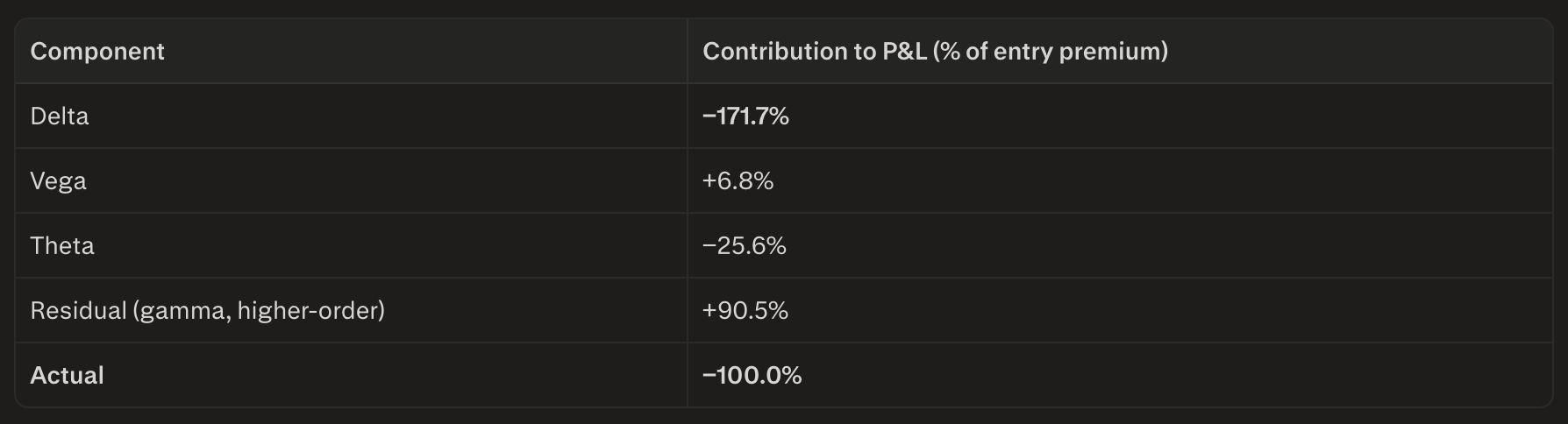
Delta did the damage. NVDA moved $7 against the call from the proxy entry to the close, and the position was long 0.69 delta out of the gate, which was enough by itself to zero the trade before theta and vega even needed to finish the job. Theta contributed its usual drag, and vega was mildly positive only because VIX rose intraday — not because the vol structure was doing anything favorable for the buyer. The +90.5% residual is what the linear delta approximation misses at a fixed point (the delta itself was falling as the stock moved down, so a naive delta × move estimate overstates the loss). But the residual doesn’t rescue the trade, and on this trade, nothing else was going to either.
The Two Things That Looked Wrong at the Wednesday Close
If you had judged the pre-event thesis on Wednesday’s 4pm print, you would have concluded that two of its three legs broke.
The vol-crush leg looked wrong. The pre-event piece argued that VIX has crushed on 16 of 28 historical FOMC days — a 57% base rate. On Wednesday, VIX rose from 18.21 to 20.66, a 13.45% intraday climb, which meant anyone long a 0DTE call with a small positive vega contribution actually got a mildly favorable surprise on that leg. On the Wednesday close alone, it looked like the vol crush had failed on this specific event.
The NVDA-amplifier leg also looked wrong. The pre-event piece argued that NVDA’s beta to SMH on FOMC days runs 1.37 versus an all-days beta of 1.10, meaning NVDA is historically the amplifier within the semi complex on decision days. On Wednesday, NVDA fell 3.55% while SMH fell 4.79% — a single-day ratio of 0.74, which is NVDA absorbing rather than amplifying. On the Wednesday close alone, that’s a real miss.
Then Thursday Happened
VIX closed Thursday at 17.09, a 17.3% single-day drop from Wednesday’s 20.66 that put it 6.15% below where it started Tuesday. Measured over the tm1-to-tp1 window the historical dataset actually uses, VIX crushed on this event just like the base rate said it would — it just did it on a delay, which isn’t a failure of the thesis so much as a rescheduling of it.
And this is a pattern the dataset already contains. Post-decision uncertainty spikes on the print and unwinds within a session, which is why the pre-event piece implicitly used the tm1-to-tp1 window when it computed the 57% VIX-drop base rate in the first place. Wednesday’s spike is fully consistent with that data once you extend the horizon by one session.
NVDA gets the same reframe. It closed Thursday at $195.04, a 2.65% bounce from Wednesday, and measured tm1-to-tp1 the two-day move works out to −1.00% — a mean-reverting move of ordinary size rather than a hawkish repricing. The −3.55% single-day drop looked like a durable shift, but the −1.00% two-day drop is closer to noise around a level.
For the 0DTE trade specifically, only Wednesday’s close matters, because the contract does not exist on Thursday. But for the historical dataset — and for any structure with more than one day of time value — the tm1-to-tp1 window is the honest measure, and it says the mechanism held.
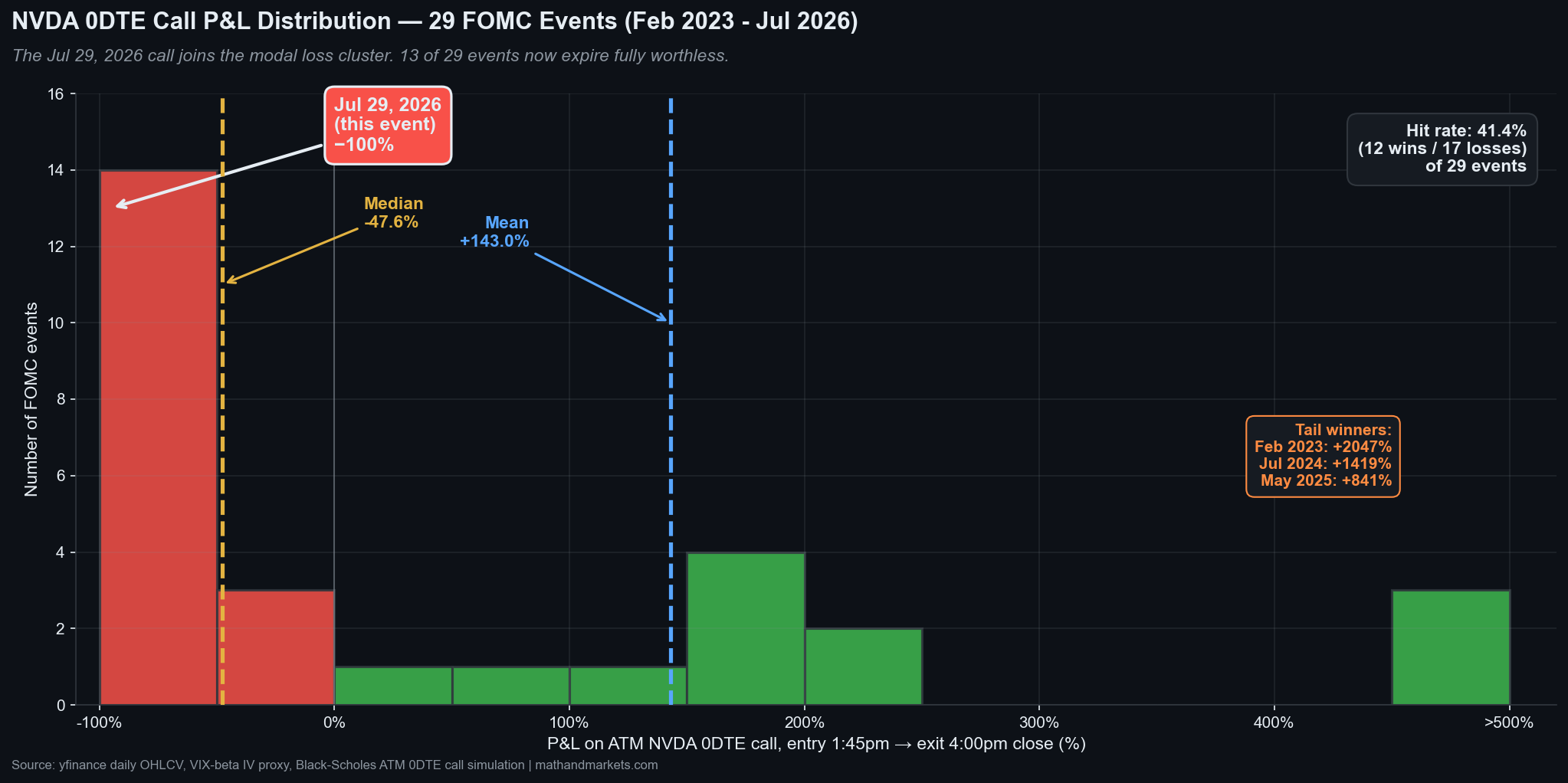
Updated distribution: 29 events, Jul 29 highlighted on the −100% bar, mean +143.0%, median −47.6%, 13 of 29 fully worthless.
Where July 29 Lands in the Distribution
July 29 becomes the 29th event in the dataset. It joins the largest single cluster of outcomes: the 12 prior events where the ATM call expired fully worthless. That count is now 13 of 29, or 44.8% of the sample.
Updated numbers:
Hit rate falls from 42.9% to 41.4%
Median moves from −45.6% to −47.6%
Mean drops from +151.7% to +143.0%
But the tail-dominated structure is intact. Three of 29 days — 10.3% of events — still carry the entire positive average.
July 29 is not the tail. It is the middle of the modal loss cluster. NVDA moved 3.55% in the wrong direction, which is a real move but well short of the 7%+ magnitudes required to produce an outsized winner. This is exactly the base case the pre-event factbook flagged: a normal-sized FOMC-day move, on the wrong side of the strike, losing the full premium to adverse delta and theta.
The Structural Read
The most useful thing to take away from the two-day data isn’t whether the pre-event piece was right or wrong on any given leg. It’s that the 0DTE structure itself foreclosed the mechanism the pre-event piece was describing.
The vol crush was real and it did happen, but it happened at Thursday’s close, roughly 24 hours after the 0DTE contract had already expired. A trade structure that dies at 4pm Wednesday can’t benefit from a mechanism that arrives at 4pm Thursday, and that’s not a bug in the 0DTE trade so much as a description of what the 0DTE trade actually is.
A 0DTE call is a bet that the mechanism you care about will arrive during the 2.25 hours the contract is alive. On July 29, it didn’t.
Same story on the NVDA move. The single-day drop of 3.55% was a real adverse move for a call buyer, but the two-day drop of 1.00% is a much softer move, and a structure that could hold through Thursday would have clawed back most of the delta damage. The 0DTE call gave up that optionality by design.
What Comes Next
Tomorrow: Part 2 of the 0DTE Autopsy arc. NVDA prints earnings Wednesday Aug 27, and the same short-dated call structure is worse into an idiosyncratic vol event than it was into FOMC. The mechanism shifts from macro mispricing to earnings-day IV crush, but the retail buyer is still on the wrong side of it — and this time, the 1DTE alternative is on the table.
This post is not a trade recommendation. It’s a recap of what a specific trade, and a postmortem on the mechanism that made it fail. Alpha is never guaranteed and the backtest is a liar until proven otherwise. Do your own research and eat your vegetables.