
Venezuela Crisis Oil Trading Strategy III: Implementation
Part 3: Implementation — Option Structures, Position Sizing, and Risk Management

This is PART 3 of a standalone series on the Venezuela Crisis Oil Trading Strategy.
It’s Monday and I wanted to get this published before the markets open!
Parts 1 and 2 established the thesis: the Venezuela shock is primarily a volatility and relative value opportunity, not a directional oil bet. Services (SLB/BKR) and refiners (VLO) are the cleanest expressions, with volatility ownership as the meta-trade across all scenarios.
Now we can talk implementation.
This part covers specific option structures, position sizing rules, and portfolio blueprints for conservative, moderate, and aggressive risk appetites. I’ll include strike selection logic, roll plans, and the math behind sizing decisions.
First Principles: Why Options?
The Exchange Sacrifice
In chess, an exchange sacrifice is when you give up a rook (worth 5 points) for a knight or bishop (worth 3 points). On paper, you’re down material. But you’re trading static value for dynamic compensation — better piece coordination, control of key squares, or attacking chances that are hard to quantify.
Options premium works the same way.
When you buy a collarized call spread instead of holding the underlying, you’re sacrificing some upside (the cap) and paying theta (time decay). On a spreadsheet, the expected value of owning the stock outright might look higher.
But you’re getting something the spreadsheet doesn’t capture:
Defined risk — You know your max loss before you enter
Convexity — Small premium, asymmetric payoff in tail scenarios
Flexibility — Capital freed up for other positions
Survivability — You can be wrong on timing and still stay in the game
Petrosian, the world champion famous for prophylactic play, once said: “Some sacrifices are sound, the rest are mine.” His opponents couldn’t calculate whether his sacrifices were brilliant or bluffs — and that uncertainty itself was an edge.
The structures in this section are Petrosian trades. We’re giving up some expected value on the best-case path in exchange for robustness across all paths. The half-Kelly sizing, the defined-risk structures, the roll discipline — these aren’t concessions in my view. They ARE the strategy.
The WSBer sees the capped upside and thinks we’re leaving money on the table. Readers of Math & Markets (hopefully) see a position that survives long enough for the thesis to play out.
On a serious note, for a scenario-driven thesis with high uncertainty, options are the right tool for several reasons:
Defined risk: Premium paid is max loss
Convexity: Asymmetric payoff if tail scenarios materialize
Flexibility: Can express views on direction, volatility, or both
Capital efficiency: Free up capital for diversification
The downside is theta decay — time eats your position (r/thetagang celeberates). The structures below are designed to minimize bleed while maintaining exposure to the scenarios we care about.
Strategy Menu (Ranked by Clarity of Edge)
Strategy 1: Long Energy Volatility
Goal: Monetize repeated repricing events
Edge clarity: High (policy fog is persistent)
Strategy 2: Long Services vs. Short Energy Beta
Goal: Isolate rebuild/capex factor
Edge clarity: High (works across most scenarios)
Strategy 3: Long Refiners vs. Short Upstream
Goal: Capture heavy crude economics
Edge clarity: Medium-high (depends on supply dynamics)
Strategy 4: Claims Optionality
Goal: Monetize settlement probability
Edge clarity: Medium (timing uncertain)
Strategy 5: Fade Oil Spikes (Conditional)
Goal: Exploit oversupply regime
Edge clarity: Lower (requires disruption to NOT occur — yes, really)
Detailed Option Structures
A. Core: Long Volatility Without Excess Bleed
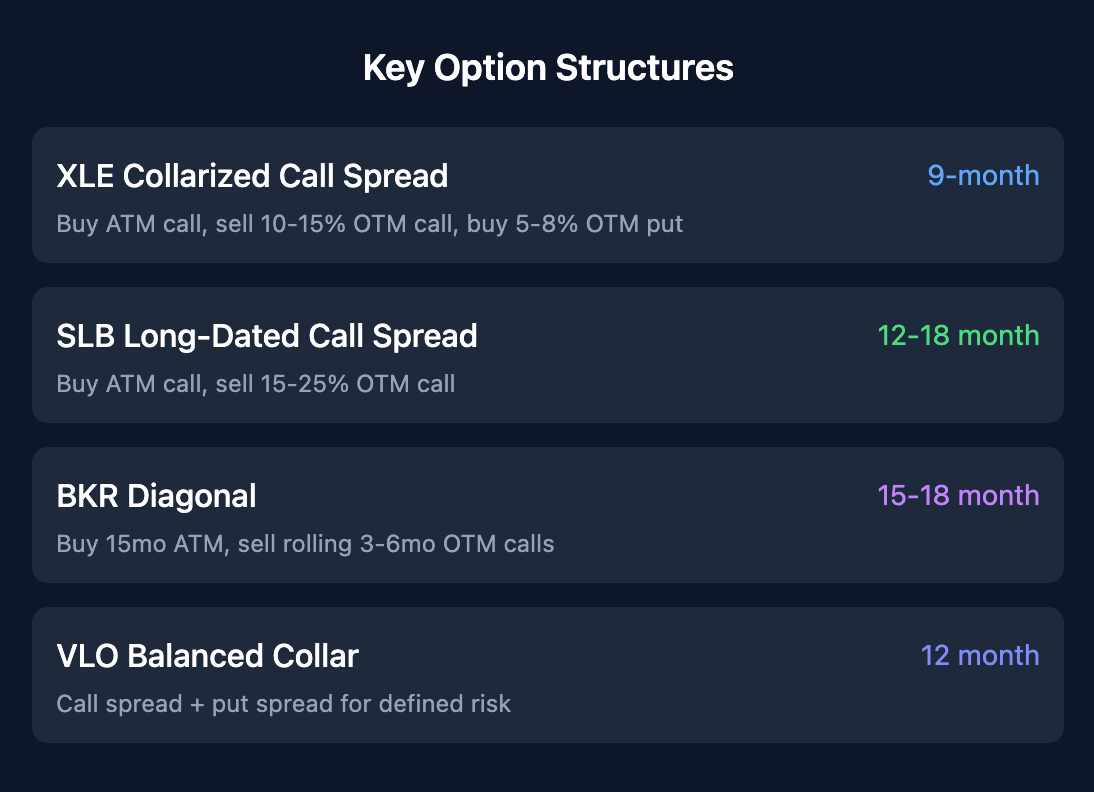
Structure 1: XLE Collarized Call Spread (6–12 months)
This is the primary volatility expression. We’re buying upside participation, defining our downside, and funding part of the structure with premium collection.
Construction:
Buy ATM call (e.g., XLE $92 call if spot = $92)
Sell 10-15% OTM call (e.g., $103 call)
Buy 5-8% OTM put (e.g., $87 put)
Sell 15-20% OTM put (e.g., $78 put)
Payoff Profile:
Max gain: Capped at upper call strike minus entry cost
Max loss: Defined by put spread width
Breakeven: Near ATM
Theta: Significantly reduced vs. naked calls
Tenor: 9 months preferred (balances theta decay vs. time for scenarios to play out)
Roll Plan:
Roll at <4 months to expiry to avoid accelerating theta
If IV spikes: Take partial profits on call side, maintain put hedge
If spot rallies past short call: Roll short call up and out
Why this works: You participate in upside moves (policy clarity, OPEC+ tightening) while the collar structure reduces bleed. The sold put funds part of the hedge.
Structure 2: USO/BNO Put Spread Funded by Small Call (9–12 months)
This structure aligns with the “spike fades” thesis—oil rallies sell off in an oversupplied market.
Construction:
Buy 5% OTM put (e.g., USO $68 put if spot = $72)
Sell 15% OTM put (e.g., $62 put)
Sell 15-20% OTM call (small size, e.g., $84 call) to reduce net debit
Payoff Profile:
Profits if oil fades after spikes
Defined loss on put spread
Short call is a funding mechanism, not a core view
Adjustment Rule: If disruption scenario emerges (sabotage, escalation):
Buy back short call immediately
Convert to call spread or outright long
Why this works: Aligns with base case (oversupply persists), but the adjustment rule protects against being wrong.
B. Satellite: Rebuild/Rehabilitation Trades
Structure 3: SLB Long-Dated Call Spread (12–18 months)
Services are the high-conviction play. This structure gives time for the rehabilitation narrative to develop.
Construction:
Buy ATM or slightly ITM call (e.g., SLB $42 call if spot = $44)
Sell 15-25% OTM call (e.g., $52 call)
Tenor: 12-18 months (Act II/III timeline)
Payoff Profile:
Capped upside, but realistic target range
Reduced cost vs. outright call
Theta manageable at longer tenors
Scaling Plan:
Enter 50% position now
Add second 50% if tenders/contracts announced (Act II confirmation)
Ladder the second tranche 3 months after first
Why this works: Services lead the recovery story. The long tenor gives scenarios time to unfold without forcing a near-term resolution.
Structure 4: BKR Diagonal Call Spread (Multi-Leg, 15–18 months)
A diagonal harvests elevated IV on the short leg while maintaining long convexity.
Construction:
Buy 15-18 month ATM call (e.g., BKR $38 call, 15 months out)
Sell 3-6 month 10-15% OTM call (e.g., $42 call, 4 months out)
Roll the short call 2-3 times as it expires
Management:
Each time short call expires worthless: Collect premium, sell next 3-6 month OTM call
If stock rallies through short strike: Roll up and out, or close
Stop Selling Short Calls If:
IV collapses below historical average
Clear catalyst crystallizes (you want full upside participation)
Why this works: You’re getting paid to wait. The short calls fund your long position while you wait for Act II/III.
Structure 5: Services vs. Majors Pair (Option Expression)
This pairs trade isolates the capex/rehab factor from commodity direction.
Construction:
SLB/BKR side: Call spreads (as above)
XOM/CVX (or XLE) side: Put spreads
Example:
Long SLB 12-month $42/$52 call spread
Long XOM 12-month $100/$90 put spread (profits if XOM underperforms)
Why this works: If the Venezuela story is “rebuild” rather than “oil up,” services outperform majors. This structure profits from that divergence regardless of oil direction.
C. Refiners: Heavy Crude Economics
Structure 6: VLO Balanced Collar (12 months)
Construction:
Buy ATM call (e.g., VLO $135 call if spot = $135)
Sell 15% OTM call (e.g., $155 call)
Buy 10% OTM put (e.g., $122 put)
Sell 20% OTM put (e.g., $110 put)
Sabotage Adjustment: If disruption/sabotage risk rises:
Do NOT sell the downside put
Keep it as tail protection
Accept higher net debit
Why this works: Refiners benefit from normalized heavy crude supply OR from tight crack spreads. The collar manages both upside and downside while maintaining the core thesis.
D. Event Optionality: Claims
Structure 7: COP LEAPS Call Spread (12-18 months)
Construction:
Buy ATM LEAPS call (e.g., COP $98 call, 15 months out)
Sell 20-30% OTM call (e.g., $120 call)
Sizing Rule:
Treat like venture capital - size for total loss acceptable
Maximum 1-2% of portfolio
Scale only if settlement mechanisms become credible (court decisions, new government announcements)
Why this works: Claims are binary. Either they get addressed or they don’t. LEAPS give time for the legal/political process to unfold.
E. Long-Term Optionality: Critical Minerals
Structure 8: Mining/REE LEAPS (18-24 months)
This is an Act IV+ play - only deploy if you believe the Syria or Stabilization scenarios are likely AND have a multi-year horizon.
Construction (choose one or combine):
Gold miners (supply disruption OR entry optionality):
Buy NEM or GDX 18-24 month ATM call
Sell 25-30% OTM call to reduce cost
Thesis: Either Venezuela gold supply gets disrupted (bullish gold) or U.S. miners eventually get access
Critical minerals (rare earth/coltan optionality):
Buy MP Materials (MP) 18-24 month call spread
Strike: ATM / 30% OTM
Thesis: If Venezuela’s rare earth deposits prove commercial and U.S. gains access, MP benefits from validation of Western rare earth thesis
Mining equipment (rehabilitation infrastructure):
Buy CAT 18-24 month call spread
More diversified - captures general infrastructure rebuild, not just Venezuela
Sizing Rule:
Maximum 2-3% of portfolio combined
This is a “lottery ticket” allocation
Only add after clear signals of mineral sector policy (tenders, Orinoco Mining Arc announcements)
Key triggers to watch:
Any mention of mining tenders or Orinoco Mining Arc policy
Chinese company expulsions from mining sector
U.S. critical minerals task force announcements re: Venezuela
Why this works (or doesn’t): Minerals are a longer timeline than oil (infrastructure is worse, regulatory framework non-existent). But the strategic importance of critical minerals means U.S. policy may stay committed longer. This is optionality on U.S. persistence, not near-term production.
Position Sizing Framework
Kelly Criterion Application
From Part 1, our Monte Carlo analysis showed:
Expected 6-month Brent move: +$3.57 (probability-weighted, minerals-adjusted)
Standard deviation: ~$5.50
Sharpe-like ratio: ~0.65
Full Kelly = EV / Variance = $3.57 / ($5.50)^2 = ~12%
Half-Kelly (conservative): 6% of portfolio in aggregate Venezuela thesis
But this is spread across multiple structures, not one position.
Suggested Risk Budget Allocation
Conservative Portfolio (Volatility Hedge + Small Optionality)
CONSERVATIVE ALLOCATION
───────────────────────────────────────────────────────
Position                    Allocation    Structure
───────────────────────────────────────────────────────
XLE collarized call spread  40%           Core vol exposure
SLB call spreads            25%           Rebuild optionality
VLO structure               15%           Heavy crude play
BKR diagonal                10%           Additional services
USO put spread              10%           Fade spike expression
───────────────────────────────────────────────────────
Entry signals: Vol not elevated vs. realized, calm tape before policy resolution Stop conditions: Durable quarantine/blockade with no reopening path
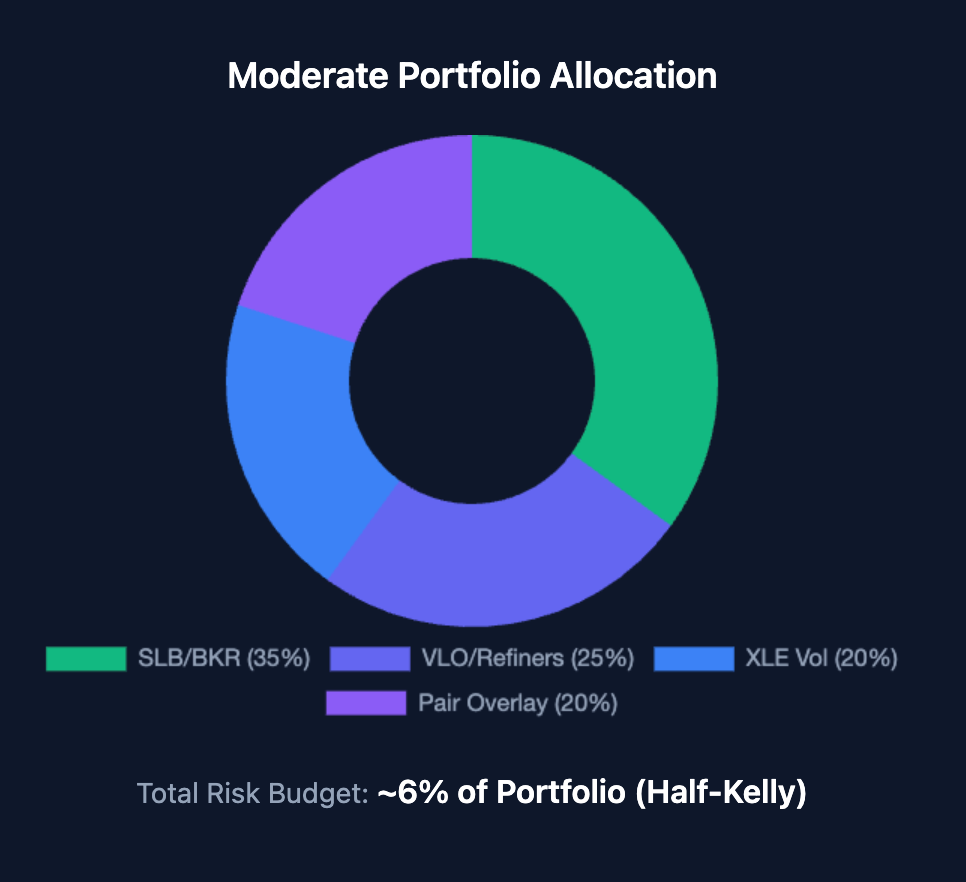
Moderate Portfolio (Relative Value Rebuild)
MODERATE ALLOCATION
───────────────────────────────────────────────────────
Position                    Allocation    Structure
───────────────────────────────────────────────────────
SLB/BKR call spreads        35%           Primary thesis
VLO/refiners                25%           Heavy crude economics
XLE vol structure           20%           Volatility participation
Pair overlay (short upstream) 20%         Factor isolation
───────────────────────────────────────────────────────
Entry signals: Evidence of reopening—tenders, licensing, transitional authority Stop conditions: OPEC+ deep cuts (rotate to upstream), sustained blockade
Aggressive Portfolio (Tail Risk Barbell)
AGGRESSIVE ALLOCATION
───────────────────────────────────────────────────────
Position                    Allocation    Structure
───────────────────────────────────────────────────────
XLE vol + upside            25%           Core expression
Oil upside tail calls       20%           Escalation optionality
SLB/BKR convexity           25%           Rebuild upside
COP claims optionality      10%           Settlement lottery
Mining/REE LEAPS            10%           Minerals optionality
EM hedge                    10%           Downside protection
───────────────────────────────────────────────────────
Entry signals for minerals: Mining tender announcements, Orinoco Arc policy shifts
Stop conditions: Clear de-escalation + negotiated transition + no disruption
I can’t stress this enough: please be warned that this is obviously a high-risk, high-reward allocation — you need to have clearly defined exit criteria if you go with this portfolio allocation. Risk management is key!!
Risk Management Rules
Position-Level Rules
Maximum single position: 5% of portfolio at entry
Maximum sector concentration: 15% in any one sector
Total Venezuela thesis: Capped at half-Kelly (~6% of portfolio)
Stop-loss on directional futures: 3% adverse move triggers review
Calendar spread stop: $1 spread contraction triggers exit
Portfolio-Level Rules
Correlation awareness: Services and refiners are both energy—they can move together
Hedge requirement: Aggressive portfolios must include EM/LATAM or macro hedge
Roll discipline: Roll at <4 months to expiry, no exceptions
Profit-taking: Scale out 25% if position hits 50% of max gain
Scenario Revision Rules
Update probabilities weekly. Major triggers that shift the distribution:
SCENARIO REVISION TRIGGERS
───────────────────────────────────────────────────────
Trigger                      Probability Shift
───────────────────────────────────────────────────────
Machado sworn in             Syria: 15% → 40%
Major Caracas violence       Libya: 50% → 70%
Russia/China military aid    Escalation: 5% → 15%
Exxon announces return       Syria: 15% → 35%
Chevron evacuates            Libya: 50% → 75%
───────────────────────────────────────────────────────
When probabilities shift materially (>15% on any scenario), rebalance positions accordingly.
Implementation Timeline
Week 1 (Now)
Establish core XLE vol position (Structure 1)
Initiate 50% of SLB position (Structure 3)
Set alerts for key trigger events
Week 2-4
Add VLO position after UN Security Council meeting clarity
Consider USO put spread if spike occurs and fades
Month 2-3
Complete SLB/BKR build-out if tender activity begins
Initiate pairs trade (services vs. majors) if rehabilitation narrative strengthens
Month 6+
Reassess entire framework based on which Act we’re in
Add claims optionality only if settlement path becomes credible
What This Doesn’t Cover
To be completely transparent about limitations:
Execution risk: Bid-ask spreads on longer-dated options can be wide
Liquidity risk: SLB/BKR options less liquid than XLE
Correlation assumptions: Scenarios are not mutually exclusive; hybrids occur
The Trump factor: The current administration has shown itself to be a bit of a wild card, so it is important to factor that into any decision-making process
Black swan: None of these structures protect against true left-tail events (nuclear, pandemic, etc.) — that includes policy changes out of the blue
My own uncertainty: These probability estimates are subjective; I could be wrong (and very, very often, I am!)
Key Takeaways (Part 3)
Collarized call spreads are the core volatility expression - reduced bleed, defined risk
Long-dated service calls align with the rehabilitation timeline (12-18 months)
Diagonals let you harvest IV while waiting for catalysts
Pairs trades isolate the “rebuild” factor from oil direction
Half-Kelly sizing suggests ~6% total portfolio allocation to Venezuela thesis
Claims are venture bets - size for total loss acceptable
Minerals are Act IV+ optionality - 18-24 month LEAPS, lottery ticket sizing
Roll at 4 months - no exceptions, theta accelerates after that
What’s Next
In Part 4, the decision framework — what triggers cause us to update probabilities, how OPEC+ decisions shift the regime, and an operational playbook for the next 6-18 months.
Remember: Alpha is never guaranteed. And the backtest is a liar until proven otherwise.
These posts are about methodology, not recommendations. Some of the approaches discussed here involve commodities (like oil) and complex instruments (e.g., options and derivatives) and not suitable for all investors. Many of my analyses probably contain errors — if you find them, please let me know.
While I may hold positions in some of the underlying assets discussed here, my posts are not an endorsement or a recommendation of those underlying assets. This is a quickly emerging and fast-changing situation, so please be wary of information staleness.
The material presented in Math & Markets is for informational purposes only. It does not constitute investment or financial advice.