
Hedge Sizing vs. Alpha Sizing: Why I Don’t Dynamically Size the Volatility Sleeve
Part 7 below talks about my experiments in using the volatility sleeve

This is part 7 of my series — Building & Scaling Algorithmic Trading Strategies
When I first added the volatility sleeve, I treated it like a hedge: something that would offset allocator drawdowns, add convexity during stress, and support the portfolio when the long–short strategy struggled.
But the data didn’t agree.
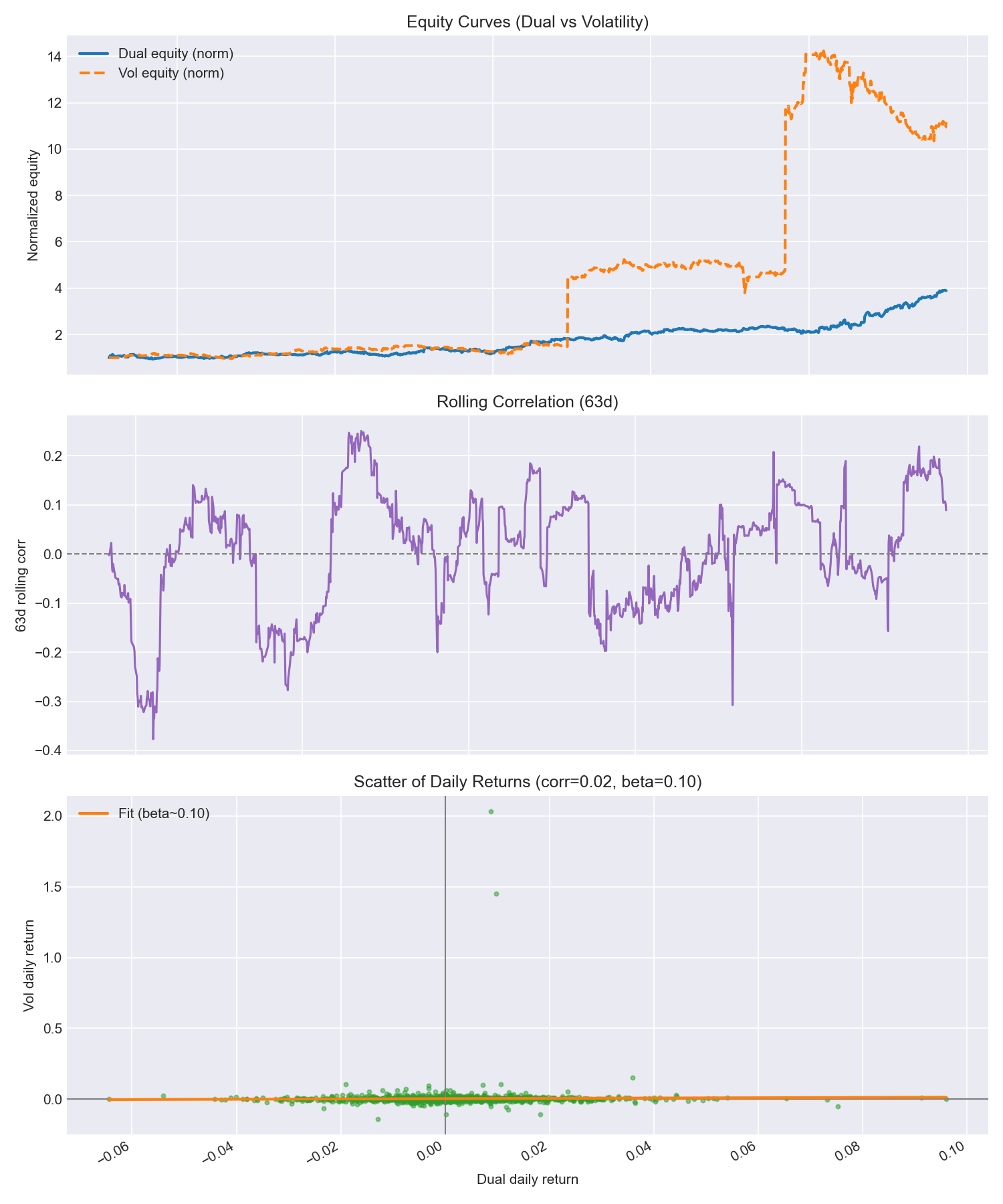
After running the full 1,281-day aligned window between my vol sleeve and dual sleeve, the conclusion was clear:
This isn’t a hedge.
It’s an uncorrelated alpha sleeve with a completely different payoff profile.
This changes how I size it — and more importantly, how I don’t size it.
1. What the Metrics Say (Why This Isn’t a Classic Hedge)
Here’s the snapshot over the aligned 1,281-day window:
Volatility Sleeve (term-structure trades)
ROI: +1,016.6%
CAGR: 60.8%
Sharpe: 0.70
Max drawdown: –28.0%
Huge absolute return, explosive convexity in certain windows — but path-dependent, uneven, and with high volatility of volatility.
Dual Sleeve (long–short allocator)
ROI: +299.8%
CAGR: 31.3%
Sharpe: 1.29
Max drawdown: –19.5%
Much smoother. Controlled. Predictable. A compounding engine.
Correlation & Beta (the important part)
Overall correlation: ~0.02
Beta vs dual: ~0.10
This is almost shockingly low.
It means the sleeves are independent. The vol sleeve isn’t riding the allocator’s trends. It’s doing its own thing.
This is not hedge behavior.
Hedges tend to be:
negatively correlated, especially in the left tail, and
strongly positive when the core strategy is negative.
The vol sleeve is neither.
2. Stress Behavior: The Reality Check
Let’s look at what happens when the allocator is under pressure.
When the dual sleeve is negative:
Correlation: ~0.00
Vol sleeve average daily return: +0.04%
Slight positive drift — not nothing, but not a hedge.
Dual’s worst 5% days:
Correlation: ~–0.20
Vol sleeve average return: –0.20%
This is worse: on the truly bad allocator days, the vol sleeve sometimes loses money.
A hedge should defend the left tail.
This sleeve occasionally joins the pain.
During the allocator’s worst drawdown window:
Correlation: ~0.20
Vol sleeve total return: +0.52%
A mild cushion — but modest. Not structural.
3. Conclusion: This Sleeve Behaves Like Orthogonal Alpha, Not a Hedge
The numbers force a reframing.
It’s uncorrelated most of the time.
It’s mildly supportive in shallow drawdowns.
It fails to hedge deep allocator left tails.
It has independent convex bursts that have nothing to do with allocator pain.
Put differently:
It’s an alpha sleeve with high convexity and high variance —
not a hedge sleeve with negative beta.
That means all hedge logic — tail-hedge sizing, drawdown-triggered expansion, volatility gating — is the wrong mental model.
It’s not a seatbelt.
It’s a second engine that happens to fire at different times.
4. So How Do You Size It? (And What I’m Actually Doing)
A. Alpha sizing logic, not hedge sizing logic
Because it’s alpha, not protection, its sizing should obey alpha rules:
small but meaningful (% NAV)
hard-capped
independent of daily dual signals
reviewed periodically, not continuously
run at stable exposure unless a regime shift justifies change
No dynamic risk-off sizing.
No “add more when dual is weak.”
No “size down when allocator is strong.”
None of that works when correlation ≈ zero.
B. The volatility sleeve becomes an orthogonal convexity engine
Its job is:
hit home runs during volatility expansions
contribute in bursts
remain flat or small during grind periods
diversify allocator path dependency
operate on a different rhythm
This is alpha diversification, not downside insurance.
C. Review frequency: monthly or regime-based
Since it’s not a hedge, daily sizing is counterproductive.
I’ll adjust it only when:
volatility regime changes (floor → compression → breakout → panic → decay)
long-term vol-of-vol structure shifts
realized/perceived term-structure carry decouples
liquidity/borrow frictions change materially
This is slow-moving, not tactical.
5. Why I Explicitly Avoid Dynamic Sizing Here
I tested:
Sharpe-gated exposure
volatility-triggered weight scaling
adaptive blend with allocator
drawdown-linked hedge expansion
regime classifiers (entropy, vol clusters)
ML-based sizing proposals
All of them degraded forward stability.
The issue is simple:
Convex alpha does not like being resized.
Dynamic sizing kills convexity on the upside and amplifies pain on the downside.
Every “smart sizing” rule resulted in:
missing the best upside bursts
overexposing in the wrong parts of the curve
unintentionally creating pro-cyclical risk
higher turnover and more slippage
worse live performance than a simple fixed sleeve
Sometimes boring beats clever.
6. How I Now Treat the Vol Sleeve
Here’s the final logic:
It’s not a hedge.
It’s orthogonal alpha with convex episodes.
It gets a fixed allocation (small, stable).
Adjustments only occur on slow, structural regime changes.
The long-short allocator remains the core engine.
The volatility sleeve remains a separate, independent return stream.
The combination works precisely because they’re independent.
7. Summary (the rule I now follow)
Allocators:
Dynamic sizing, signal-driven, daily adaptation.Volatility sleeve:
Fixed sizing, periodic review, alpha framing —
not a hedge, not dynamically adjusted.Portfolio:
A compounding core strategy plus an orthogonal, convex alpha sleeve.
Hedges reduce left-tail exposure.
This sleeve doesn’t.
What it does is diversify the path — and that’s valuable on its own.
The information presented in Math & Markets is not investment or financial advice and should not be construed as such.