
Environment, Modules, and Data Flow (no code, just the blueprint)
Part 3 below focuses on the environment, modules, data flow, and setup for my project

This is part 3 of my series — Building & Scaling Algorithmic Trading Strategies
Here I talk about the practical setup behind my strategies: Python and C++ environment, project layout, modules, and how data moves (in and out of CSVs). No code, just enough detail for reproducibility and clean iteration.
It’s been a couple of years since I touched code, so a lot of this was new to me. In a previous era I’d have used a lot of StackExchange, but thankfully we have Codex and Claude now. Please feel free to ignore this if you know this already.
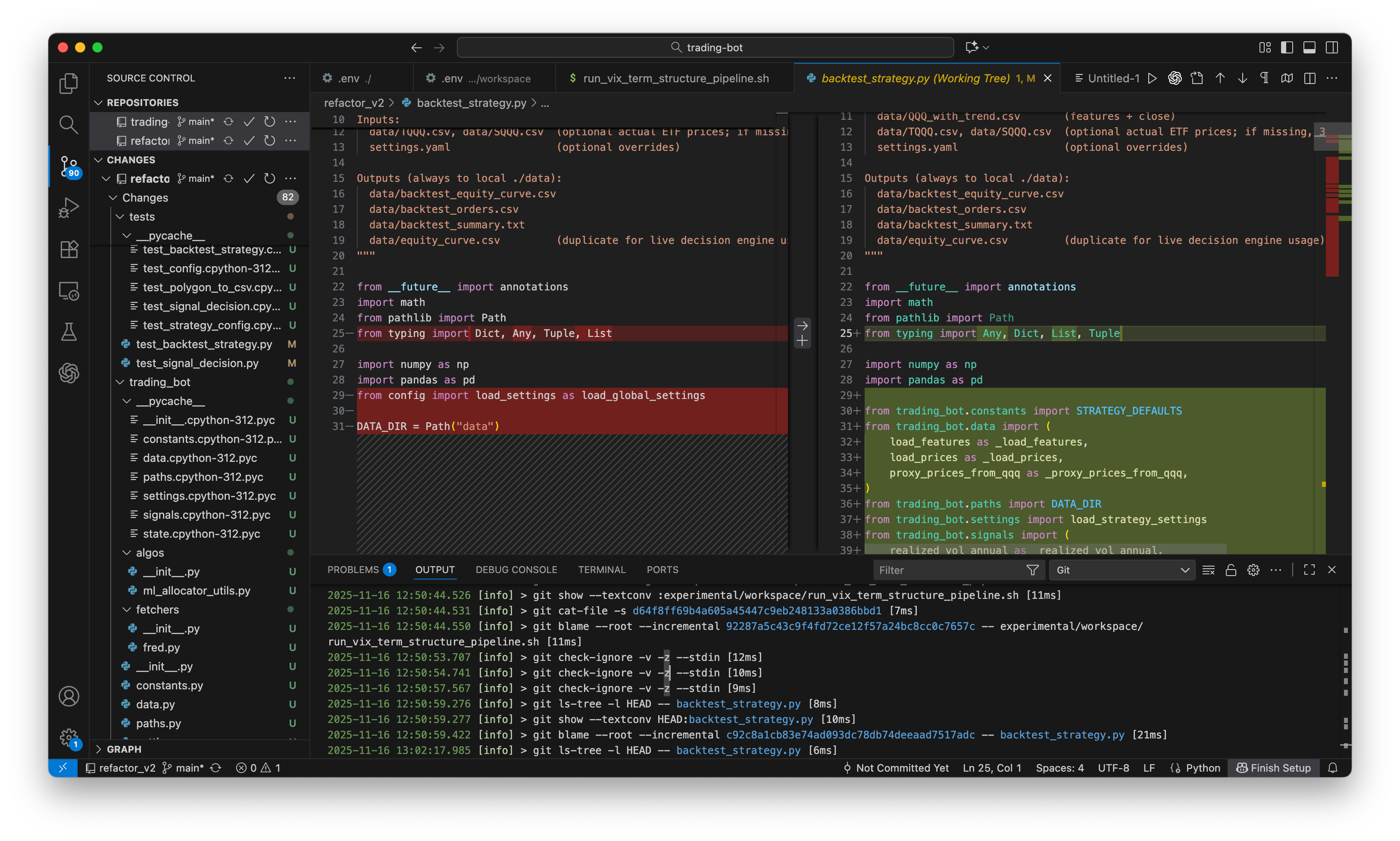
Python environment (Mac M2)
Version: Python 3.12
Isolation:
venv(simple, reliable). If you prefer, Poetry/uv are fine; the point is locked deps and repeatable installs.Core libs: pandas, numpy, scipy, statsmodels (for quick stats), matplotlib (for local plots), pydantic (config validation), requests/httpx (API), tqdm (progress), loguru (logging).
Reproducibility:
requirements.txt+ lock file (or Poetry lock).A single command to bootstrap on a fresh machine.
Pin versions for anything that touches data or math.
Notes for Apple Silicon: keep everything native; avoid mixing conda/pyenv unless you have a reason. The simpler the env, the fewer surprises. Trust me, I learned this the hard way.
And finally -- version control, version control, version control. Within the first few hours of writing this bot, I overwrote my CSVs. I use git religiously and create backups and manage version control aggressively. I also iterate fast, and version control is a godsend in managing mistakes that’ll creep in (and trust me, they will).
Project layout (modules, not monolith)
trading-bot/
  config/
    settings.yaml            # symbols, providers, paths, schedule, risk toggles
    credentials.example.env  # template for secrets (never commit the real one)
  data/
    raw/                     # provider responses (optional cache)
    curated/                 # cleaned CSVs used by the pipeline
    backtests/               # point-in-time snapshots and results
  notebooks/                 # scratch EDA only (outputs are disposable)
  logs/
    runtime/                 # daily run logs
  src/
    __init__.py
    accounts/                # account connector(s)
    providers/               # polygon, alpaca, etc.
    datastore/               # csv i/o, schemas, validation
    features/                # trend metrics, transforms
    signals/                 # signal rules & weights
    backtest/                # runners, metrics, reports
    scheduler/               # daily run orchestration
    utils/                   # common helpers (time, tz, retry)
  tests/                     # quick unit tests for math & io
  README.md
Why this structure: Each piece has one job. I can run backtests without touching providers, and adjust signals without breaking I/O.
C++ Environment (Mac M2)
Compiler / toolchain:
clangvia Xcode Command Line Tools (Apple Silicon native).Standard: C++20 (good balance of features + library support).
Build & project layout:
CMakeas the build system. Simple structure:src/for core bot logic (strategies, risk, schedulers)include/for headersthird_party/for vendored libs (or FetchContent in CMake)
Out-of-source builds only (
build/directory) to keep the tree clean.
Core deps for a trading bot:
HTTP / WebSocket:
cprorcpp-httplibfor REST (Alpaca, Polygon, etc.).websocketpporuWebSocketsif you want live feeds later.
JSON:
nlohmann/jsonfor request/response parsing.
Time & scheduling:
datelibrary (Howard Hinnant) for timezone/conversions if<chrono>isn’t enough.
Math / stats:
Eigenorxtensorfor vector math and basic linear algebra.
Logging & utilities:
spdlogfor logs.fmtfor fast, clean formatting (often bundled with spdlog).
Reproducibility / setup:
One
CMakeLists.txtat the root that configures all targets and pulls in third-party libs viaFetchContentor Git submodules.A single bootstrap sequence on a new Mac:
xcode-select --installbrew install cmakecmake -S . -B build && cmake --build build
Pin library versions via submodule tags or specific
GIT_TAGinFetchContent. Don’t trackmasterfor anything that touches execution, math, or APIs.
Notes for Apple Silicon:
Stay fully ARM-native: Homebrew under
/opt/homebrew, no Rosetta unless you absolutely must.Avoid mixing multiple compilers/package managers (no half-brew, half-MacPorts, half-conda zoo). A clean
clang + CMake + brewtoolchain on M2 is boring—and that’s exactly what you want for a live trading bot.
Configuration & secrets
settings.yamlholds non-secret config: symbols, lookbacks (50/100/250), trading window (e.g., last 10 minutes), file paths, and toggles (paper/live)..envholds secrets (API keys). Load once at startup. I’m playing fast and loose for now since it’s a paper trading account but I’ll eventually need to be more secure here.Validation: pydantic (or similar) to fail fast if a path or key is missing.
Module responsibilities (high level)
accounts/
Connect to the broker (paper first).
Query balances, buying power.
(Later) route orders. For now: dry-run only.
providers/
fetch_daily_bars(symbol, start, end) from Polygon/Alpaca.
Rate-limit aware with retry/backoff.
Idempotent: same request → same file in
data/raw/(optional).
datastore/
Schema: date, open, high, low, close, volume (index/ETF may lack volume).
Strict dtypes:
date(UTC), pricesfloat64,volumenullableInt64.Read: from
data/curated/.Write: atomic (write temp → move), no partials.
Validate: monotonic dates, no duplicates, no gaps unless documented.
features/
Compute MA50/MA100/MA250 on close.
Derive velocity = MA spreads (50–100, 100–250), normalized.
Derive acceleration = Δ(velocity) over a small window.
Output back to a features CSV (same date index).
signals/
Rule set converts features → state: LONG / NEUTRAL / SHORT.
Leverage tiering based on velocity strength + (separate) vol filter.
Hysteresis/thresholds to reduce flip-flop around zero.
backtest/
Loads curated data + features (point-in-time safe).
Applies signal states → position vector.
Computes ROI, CAGR, Sharpe, Max DD, turnover, exposure.
Writes results to
data/backtests/with a manifest (params + timestamp).
scheduler/
Daily run checklist:
load config
fetch latest bars
update curated CSVs
recompute features
recompute signal
(paper) generate hypothetical orders
log + archive artifacts
Timezone: store data in UTC, display/log in America/New_York.
CSVs: simple, fast, debuggable
Curated price CSV (per symbol):
date,open,high,low,close,volume
2024-11-01, ..., ..., ..., ..., ...
...
Sorted by
date, no missing days without an explicit reason.One file per symbol; consistent naming (
SYMBOL.daily.csv).
Features CSV (per symbol):
date,ma50,ma100,ma250,vel_50_100,vel_100_250,accel_50_100
...
Keep derived columns narrow and explicit; no mystery fields.
If I change a formula, I bump a features_version in filename.
Backtest results (per run):
run_id,asof,params_hash,cagr,sharpe,max_dd,roi,notes
...
Included the params hash so I can reproduce any chart later.
Data hygiene & integrity
Idempotent fetch: Re-running today’s job shouldn’t create duplicates. I sort by newest first and only update the latest. In a future version, I’d like to actually create a hash to verify as well.
Gaps: If a provider misses a bar, mark and carry forward; don’t invent data. I also spent a lot of time trying to figure out why a particular trade was stopped 7 days before. Well turns out a data gap in one relatively irrelevant piece of data basically meant everything stopped.
Clock discipline: Only compute today’s features after the official close timestamp; avoid using partial intraday bars in a daily system.
Audit trail: Every daily run writes a small JSON manifest (what symbols, what time, which files changed).
Logging & observability
Two logs:
logs/runtime/YYYY-MM-DD.log(human-readable)logs/runtime/YYYY-MM-DD.ndjson(machine-parseable)
Log key events: fetch window, rows added, feature ranges, signal changes, and any non-200 provider responses (with retry counts).
Testing (just enough)
Unit tests for:
MA math (edge cases: short windows, NaNs).
Velocity/acceleration correctness on small synthetic series.
CSV read/write round-trip (types and ordering).
A tiny “canary” backtest (e.g., 90 days) runs fast to catch breakage.
Daily workflow (what runs, in what order)
Fetch new daily bars (yesterday if running pre-open; same-day after close).
Curate: append, de-dup, validate.
Features: recompute last N rows (don’t recompute the world).
Signals: update trend / state + leverage tier.
(Paper) Orders: generate hypothetical trades and store.
Archive: write manifests, plots, and summaries to
data/backtests/(optional daily micro-backtest for sanity).Notify: short text summary from logs (signal state changes, risk flags).
What I’m not doing (yet)
No live order routing. Paper only.
No ML weight auto-tuning in production. Manual thresholds first, then iterate.
No database. CSVs are enough at this scale and make debugging trivial.
The information presented in Math & Markets is not investment or financial advice and should not be construed as such.